Dynamics 365
How Distributors Use Dynamics 365 to Manage Warehouse Operations
Quick Answer (TL;DR) Distributors use Microsoft Dynamics 365 to manage warehouse operations as it offers real-time visibility, automated…


When we talk about micro vertical ERPs, it is clear that these do not cater to broad industries. These are highly specialized systems fulfilling the needs of specific niches. Such systems eliminate the need for a highly customized system that can be very costly.
The Micro Vertical ERP is the need of the hour, as it helps you use an ERP system that offers industry-specific functionalities. Using a generic system is of no use. It serves no purpose as it does not fulfill the purpose of implementation.
Businesses today operate differently and need solutions tailored to how they work. Experienced Dynamics 365 consulting services can help you unlock your business’s full potential.
Traditional ERP systems were built to fulfill the needs of businesses by offering generic solutions for HR, Finance, and supply chain. Usually, these operations are the same across industries and businesses, and a single ERP system can serve them all.
Micro vertical ERPs aim to solve business challenges by providing a niche-specific solution within an industry. Therefore, ERPS are categorized as:
This type of ERP is suitable for general-purpose applications such as HR and finance, where every organization requires the same work.
Then comes the vertical ERP, suitable for specific industries and catering to broader sectors such as retail, healthcare, and education.
And now, when we speak about Micro Vertical ERP, it serves a sub-sector or a specific niche within an industry. For instance, it is designed for fabric and supplier sourcing, catering to the manufacturing industry.

The question here is: why do businesses need a micro-vertical ERP system?? The answer is customization, personalization, and efficiency. Using a generic system will stunt the growth, as it does not serve the purpose.
And the micro vertical point comes into play because industry-specific functionality, AI adoption, zero customization, and built-in regulatory compliance make it easier to do business.
The growing technological and business-centric demands make it mandatory to adopt a micro-vertical system.
Also Read: How We Rescued a Failed Business Central Implementation
Micro vertical ERP systems offer industry-specific solutions with faster implementation, greater compliance, long-term cost savings, and higher user adoption. The key aspects of the ERP include:
Using a system that does not fulfill the customer demands is not worth it. These days, businesses need specific solutions for every department to achieve greater efficiency and productivity.
So the specific solution does not require any customization or modification. The business is ready to adopt it without any fear of failure.
Time is money, and Dynamics 365 Business Central implementation saves you time. This time, implementation is faster because you do not need to spend 12-14 months on deployment. The ready-to-adapt solution is already customized and ready for deployment. This saves your valuable time.
Any small or medium-sized business can adapt it to achieve faster ROI without spending a lot.
Managing compliance can be overwhelming. Some industries have strict regulatory compliance requirements that cannot be ignored and must be managed effectively. The automation of compliance in these Micro vertical ERP saves time and maintains compliance. There is no risk of errors that lead to penalties or fines. The system is well-versed in specific industry regulations and meets them accurately.
Businesses are using task-specific AI agents to perform operations effectively. Micro vertical ERPs handle time-sensitive tasks and deliver solutions instantly. The agents use data specifically to perform the tasks.
The ERP system utilized targeted insight to solve the issues. For instance, a retail company can use AI to improve demand forecasting. A manufacturing firm can get insights into predictive maintenance as these AIs offer accurate predictions.
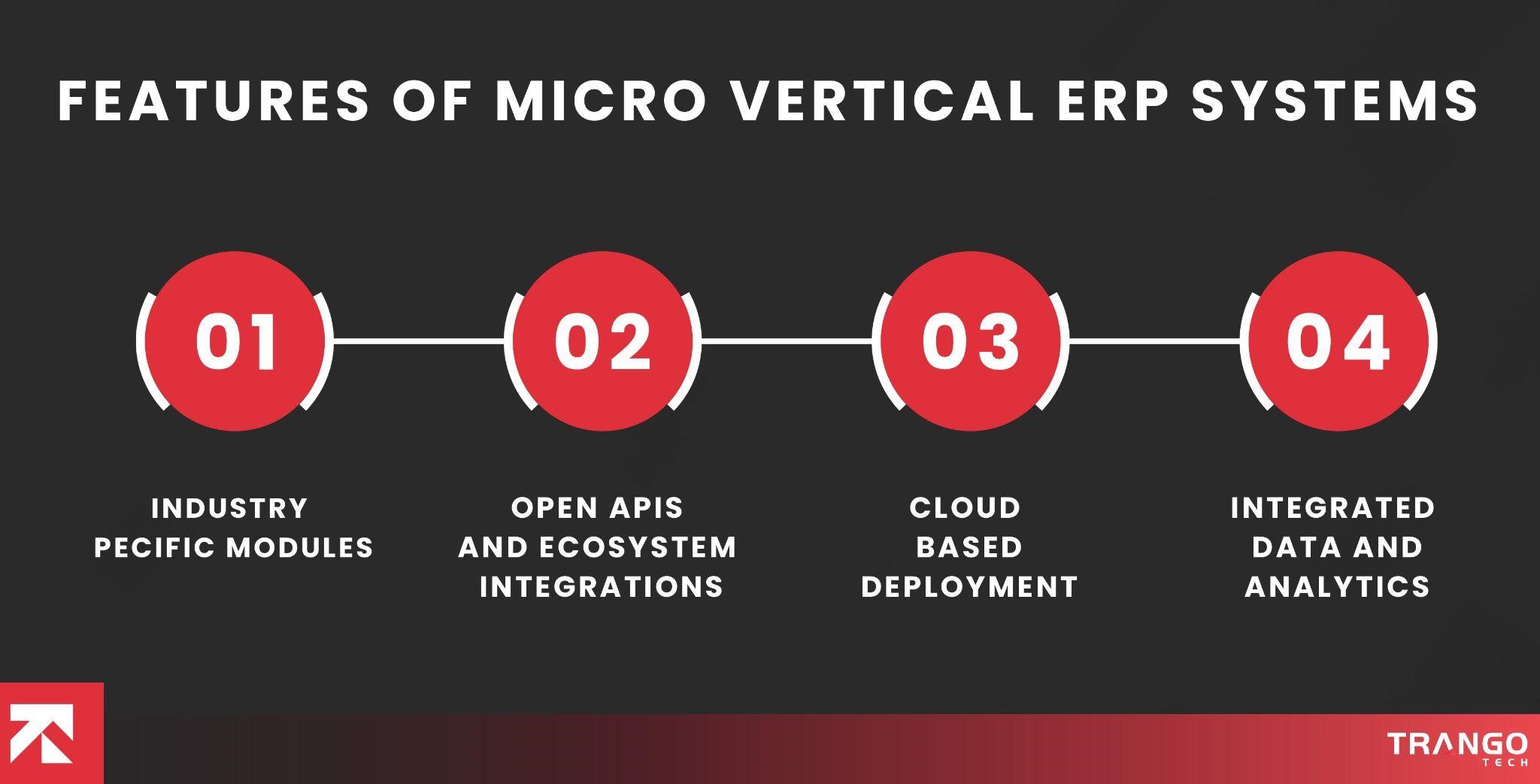
We have discovered that micro vertical ERP systems are designed to fulfill the needs of specific industries, but they share common and industry-specific functions. The features of the system include:
The foremost features are the industry-specific modules.
For instance:
The Healthcare ERP system includes appointment management, billing, and electronic medical records.
Retail ERP consists of POS management, demand forecasting, Omnichannel sales integration, and other functionalities.
Manufacturing ERP systems offer machine monitoring, shop-floor control, and other capabilities.
The specific modules are hassle-free and do not require customization.
The most significant benefit is seamless integration with other systems. The ERP system can integrate with third-party apps, tools, legacy systems, CRM, Ecommerce and payment gateways without any interruption or delay.
The cloud system offers greater flexibility, accessibility, and affordability. These systems are easy to deploy and require no heavy infrastructure. The system scales with the business and is integrated with modern technologies such as IoT, AI, and others.
The centralization of data on a single platform leads to faster reporting, greater visibility, and smarter decision-making. Departments can collaborate on data without any hassle. The dashboard is set up to offer industry-specific KPIs.
For instance, a healthcare facility can instantly access patient records and history.
Similarly, a retail store can view the inventory turnover rate.
The system provides a single source of truth, enabling businesses to easily extract data. Leaders can view data in real time, thanks to the system’s complete visibility and control.
A micro-vertical ERP system is a modern, cloud-based solution that offers remote access over the internet. The increased accessibility and automation of updates help businesses continue their operations without delay.
Also Read: Business Central vs Custom ERP for SMEs
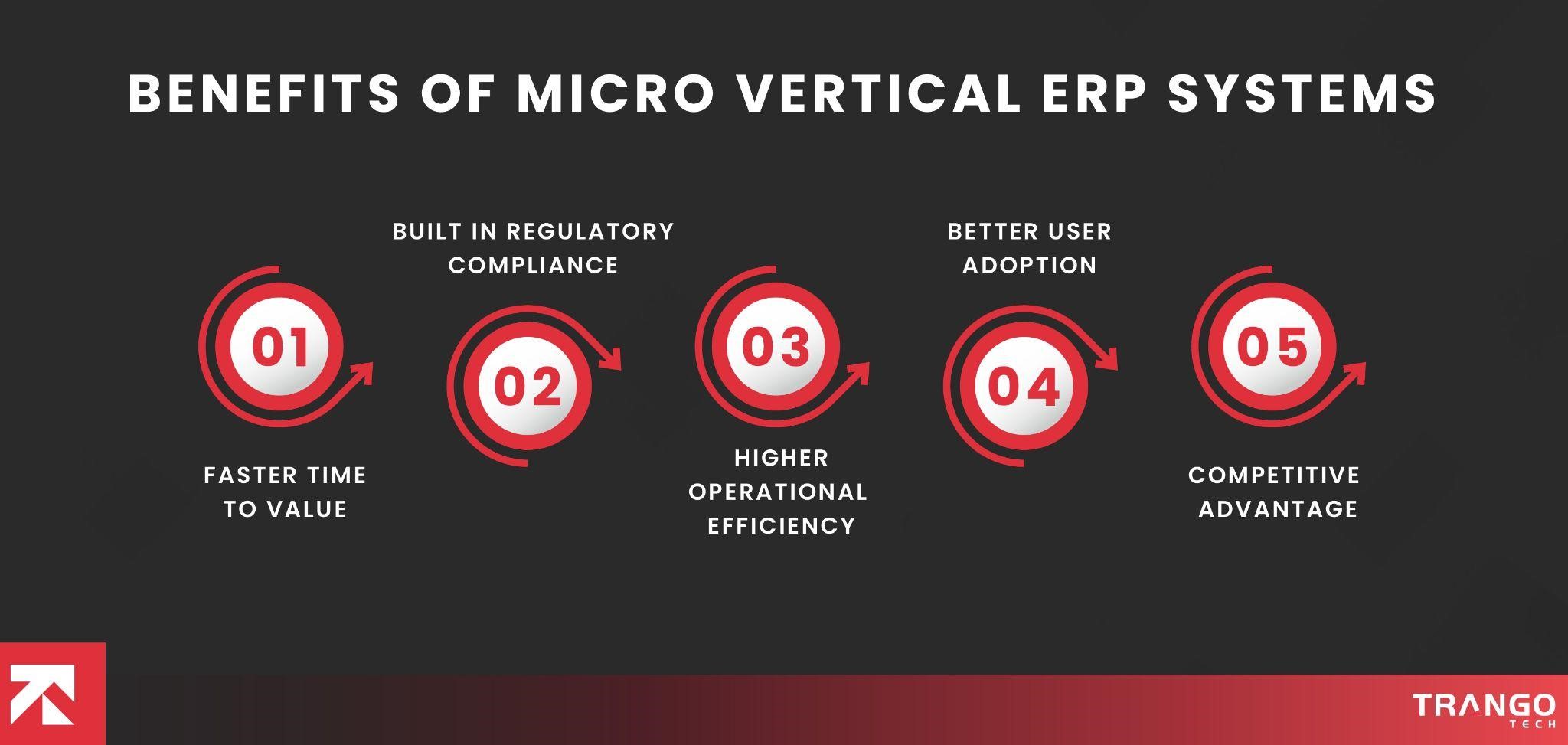
Micro vertical ERP systems offer various benefits to businesses, such as faster ROI, better user adoption, built-in regulatory compliance, and more.
The Micro vertical ERP system is already industry-specific, so you don’t need much time to implement it. It saves you a lot of months and delivers faster ROI and results you have been waiting for.
Several industries require compliance as a compulsory requirement rather than an option. Micro vertical ERP systems offer compliance with systems. From HIPAA compliance in healthcare to SOX in finance, it handles all industry-specific systems.
Aligning with industry-specific workflows allows businesses to maximize efficiency. Eliminating outdated processes and introducing automation, along with AI-powered insights and workflows, improves efficiency.
When employees use a system that eases their work, and they see results instantly, it is a shock of happiness for them. This surprise is no less than a relief to them, making adoption easier and faster.
User training becomes much easier with specific dashboards that streamline work, leading to greater data accuracy, employee satisfaction, and productivity.
Micro vertical ERP systems offer industry-specific insights that lead to better forecasting and improved operational efficiency. Gone are the days when they had limited visibility.
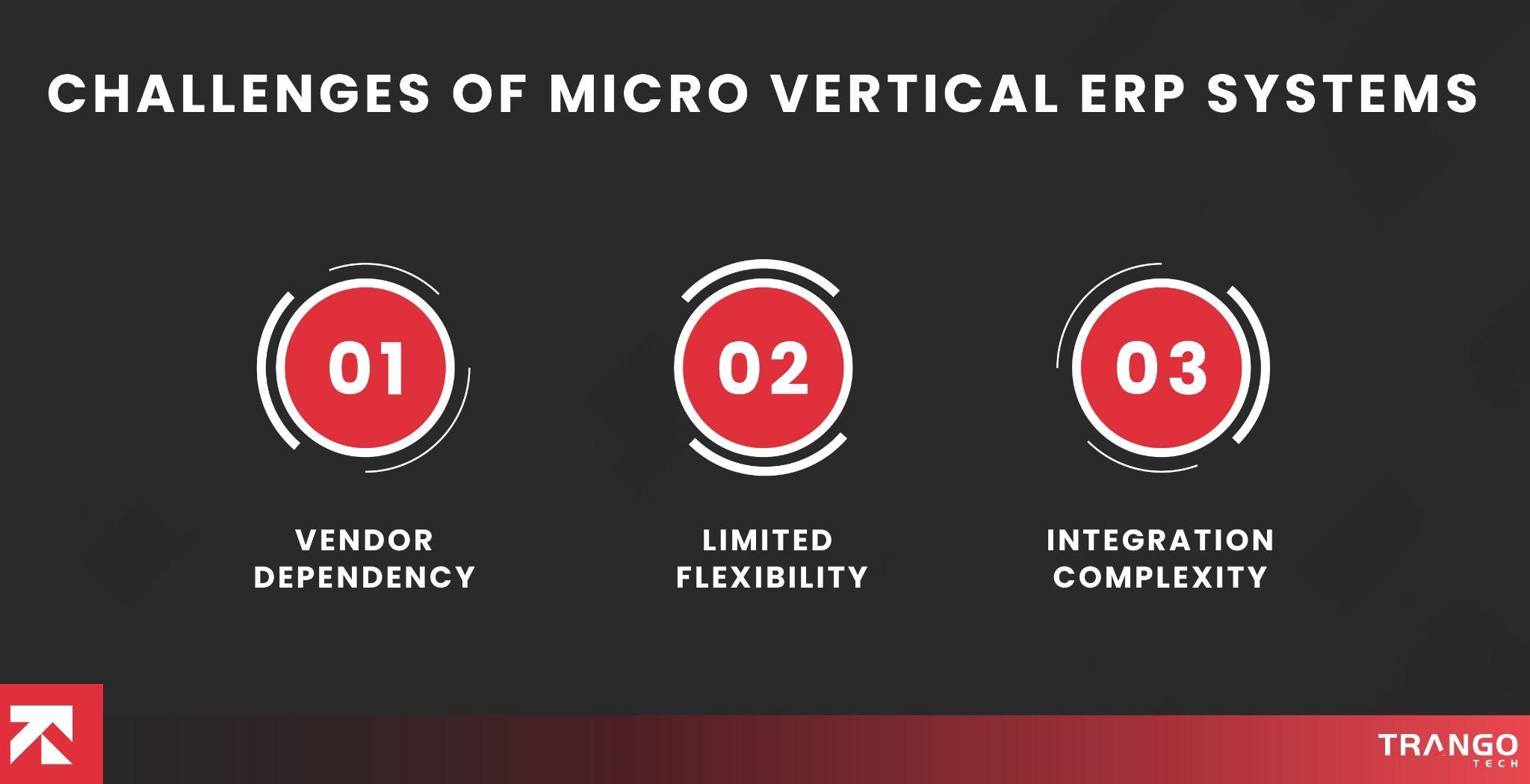
Micro vertical ERP systems offer benefits but also come with challenges.
An organization seeking to implement an ERP system needs the assistance of a vendor specializing in the relevant industry. This makes the vendor dependency a long-term bottleneck, as when they are absent or abandon the project, the business may face difficulties.
As this ERP system is already highly customized, it cannot offer more flexibility. Any business trying to expand may need it, but faces difficulty.
Integration Complexity
Connecting multiple systems may seem easy, but it requires technical expertise and a partner’s assistance.

To fully utilize the system’s potential, businesses must choose one that is easy to maintain, flexible, and scalable.
You must consider:
The micro vertical ERP must be niche, specific, and offer exactly what you want, and add value by simplifying your operations. Moreover, you should avail yourself of D365 migration services to achieve minimal downtime and no data loss.
If you need to integrate multiple systems, you must check their compatibility with other tools. Carefully assess if it goes well with other systems and connects to CRM, ecommerce, and other systems easily.
The system must scale without issues. The business’s growth is a sure thing, as you are using a highly compatible system.
Vendors play an important role in a successful implementation. Choose your vendor wisely; they need a good reputation and must offer long-term support. Regular updates are required to maintain the system, and the vendor needs to be reliable. Acquire D365 support services for around-the-clock support.
Choose a system that is easier to maintain and suitable for you, based on the resources you have or how much you can spend. A cloud solution is easier to maintain because it does not require you to spend a lot on infrastructure or setup. Moreover, it can easily scale as your business grows without any additional cost.
However, it is suitable for a small or medium-sized business with simple requirements. Businesses with complex operations need an on-premises system to fulfill their needs effectively.
Gone are the days when you were told to adjust within means. Adjustment will only lead to failure in the long term. This is why you need a system that hits the target directly. Which means it should accurately cater to your needs. This is where Micro vertical ERP steps in to prove its worth.
Abandon generic ERP solutions and adopt a micro vertical ERP fit for your business, offering the exact solution you need. It aligns with industry-specific workflows, requires minimal customization, and is easier and faster to implement.
The evolution and advancement of the system will maximize productivity and efficiency.
What is a micro vertical ERP system?
A micro-vertical ERP system offers industry-specific solutions to businesses that do not need customization and can be implemented easily.
Are these ERP systems suitable for small businesses?
Yes, these ERP systems are suitable for small businesses because they are affordable, easy to implement, and offer high ROI.
Are Micro Vertical ERPs cloud-based?
Yes, these are cloud-based solutions offering more flexibility and control to businesses and can scale easily as the business grows.
What industries does the micro vertical ERPs support?
Micro vertical ERP systems support construction, retail, healthcare, manufacturing, and professional services.
What system should a business choose for its business?
Choosing between a cloud and an on-premises system depends entirely on the unique business requirements, scalability, and cost.
How does a micro vertical ERP differ from a standard ERP system?
A micro-vertical ERP system offers industry-specific features rather than standard ones. This improves operational efficiency, and the results are visible instantly.
What are the benefits of a Micro vertical ERP system?
A micro-vertical ERP system is easy to implement, offers better ROI, and supports built-in regulatory compliance, seamless integration, and scalability.
Which businesses should use a Micro vertical ERP system?
A micro-vertical ERP system is suitable for a business that requires strict compliance and has unique requirements.
Which industries should use the Micro vertical ERP system?
A micro vertical ERP system is suitable for the food and beverage, manufacturing, distribution, finance, and retail industries.
Calculate your complete ERP implementation cost using our cost calculator.
Calculate now!
Your Email Address Will not be published. Required Fields Are Marked
Quick Answer (TL;DR) Distributors use Microsoft Dynamics 365 to manage warehouse operations as it offers real-time visibility, automated…

UN research shows that 1.3 billion tons of food are discarded before consumption. That is almost 1.3…

Quick Answer (TL;DR) Real-time inventory sync with ERP updates stock levels instantly across every sales channel whenever a…
Quick Answer (TL;DR) Distributors use Microsoft Dynamics 365 to manage warehouse operations as it offers real-time visibility, automated…
UN research shows that 1.3 billion tons of food are discarded before consumption. That is almost 1.3…
Quick Answer (TL;DR) Real-time inventory sync with ERP updates stock levels instantly across every sales channel whenever a…
If you are confused and need expert advice to transform your business, our experts are available 24/7.
Don't waste a single second, as you will be left behind while others are already ahead, moving fast. Start Now!
Trusted by Clients Worldwide: Rated 4.9 Star