ERP
Top 10 ERP Use Cases and Case Studies
Quick Answer (TL;DR) ERP systems solve real operational problems across 10 core business functions: finance, procurement, inventory, manufacturing,…


No single "best" ERP, fit depends on company size, industry, and deployment model.
Budget the whole project, not just licensing, costs run ~$20K (SMB) to $5M+ (enterprise)
Industry fit drives the most value, match the system to your vertical's core needs.
Cloud vs. on-premise is a cost-and-control tradeoff. Many systems support both plus hybrid.
Shortlist with the 30-point checklist and matrix, then run an RFP before deciding.
The top 20 ERP systems and software platforms include global ERP software like Microsoft Dynamics 365, SAP, and Oracle NetSuite, which are among the best in the industry and help businesses streamline their operations. The evaluation follows a careful analysis of functional capabilities, total cost of ownership (TCO), integration capabilities, industry alignment, scalability, and user experience.
Spreadsheets, paper documents, and disconnected software stunt growth and threaten a company’s long-term viability. Businesses need to thrive in today’s competitive landscape, but it is only possible if they get rid of manual processes. This is why they need to embrace technology like Enterprise Resource Planning software. As a Business Central Partner, we offer unmatched scalability, unlike outdated systems that cannot adapt and grow in a competitive market.
Best-fit use case, deployment options, typical Year-1 cost, and core industries for each ERP software platform. This list of ERP software covers cloud, on-premise, and hybrid options for SMBs through global enterprises.
| # | ERP System | Best For | Deployment | Typical Year-1 Cost | Key Industries |
|---|---|---|---|---|---|
| 1 | Microsoft Dynamics 365 | Flexible, cloud-first ERP + CRM | Cloud, Hybrid, On-premise | $80K–$1M+ | Manufacturing, construction, retail, professional services, healthcare, distribution |
| 2 | SAP S/4HANA | Large enterprises with complex needs | Cloud, Hybrid On-premise (limited) | $500K–$5M+ | Manufacturing, oil & gas, utilities, healthcare, life sciences, public sector |
| 3 | Oracle NetSuite | Fast-growing mid-market companies | Cloud-only | $40K–$250K/yr | Retail, wholesale distribution, eCommerce, professional services, SaaS |
| 4 | Oracle Fusion Cloud ERP | Global enterprises | Cloud-native | $300K–$3M+/yr | Banking, telecom, professional services, healthcare, manufacturing |
| 5 | Infor CloudSuite | Industry-specific solutions | Cloud (AWS) Hybrid | $200K–$2M+ | Manufacturing, healthcare, retail, hospitality, distribution, public sector |
| 6 | Epicor Kinetic | Manufacturing & distribution | Cloud, On-premise, Hybrid | $100K–$1M+ | Discrete manufacturing, automotive, aerospace, industrial equipment, distribution |
| 7 | Sage Intacct | SMB financial management | Cloud-only | $25K–$150K/yr | Nonprofits, professional services, healthcare, SaaS |
| 8 | Sage X3 | Mid-sized global businesses | Cloud, On-premise, Hybrid | $50K–$500K/yr | Manufacturing, distribution, food & beverage, pharmaceuticals |
| 9 | Acumatica | Cloud-native ERP flexibility | Cloud-nativeHybrid (via partners) | $25K–$200K/yr | Construction, manufacturing, retail, distribution |
| 10 | Odoo ERP | Open-source customization | Cloud, On-premise, Self-hosted | Free–~$24/user/mo | Retail, manufacturing, services, startups, eCommerce |
| 11 | IFS Cloud ERP | Asset-intensive industries | Cloud, On-premise, Hybrid | $200K–$2M+ | Aerospace, defense, utilities, construction, energy, mining |
| 12 | Workday ERP | HCM & financials in enterprises | Cloud-only | $250K–$2M+/yr | Education, healthcare, finance, government, large enterprises |
| 13 | Unit4 ERPx | People-centric organizations | Cloud-only | $100K–$500K/yr | Nonprofits, professional services, higher education, government, public sector |
| 14 | SYSPRO ERP | Mid-market manufacturing & distribution | Cloud, On-premise, Hybrid | $75K–$500K/yr | Manufacturing, food & beverage, automotive, industrial equipment |
| 15 | Plex by Rockwell Automation | Smart manufacturing | Cloud-only | $150K–$1M+ | Automotive, aerospace, food & beverage, high-tech manufacturing |
| 16 | QAD Adaptive ERP | Global manufacturing enterprises | Cloud, On-premise, Hybrid | $200K–$2M+ | Automotive, life sciences, consumer products, food & beverage, high-tech |
| 17 | Priority Software ERP | Agile SMBs | Cloud, On-premise, Mobile-first | From ~$50K/yr | Retail, manufacturing, healthcare, construction, professional services |
| 18 | Deltek Costpoint | Government contractors & projects | Cloud, On-premise | $100K–$1M+ | Government contractors, aerospace, defense, project-based businesses |
| 19 | Rootstock Cloud ERP | Salesforce-native ERP | Cloud (Salesforce-native) | $100K–$750K/yr | Manufacturing, distribution, high-tech, life sciences |
| 20 | Brightpearl by Sage | Retail & wholesale ERP | Cloud | From ~$80K/yr | Retail, wholesale, eCommerce, distribution |
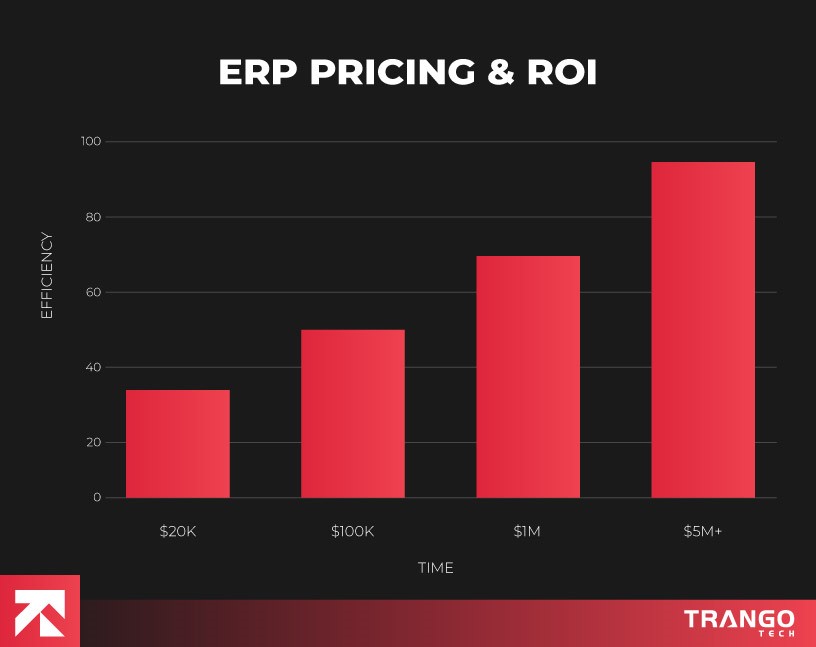
ERP costs depend on business size, deployment type (cloud vs. on-premise), user count, and customization needs. The costs may seem high, but it gets balanced when you see the ROI increases significantly over time.

ERP systems are designed for different industries to ensure all sectors have smoother workflows, compliance, and higher ROI.
Manufacturing – ERP supports production planning, inventory control, and shop floor automation to streamline operations.
Top pick: Epicor Kinetic. Built around discrete manufacturing rather than adapted to it. Shop floor control, production scheduling, and supply chain visibility ship as core functionality, and it deploys cloud, on-premise, or hybrid, which matters when plant systems can’t all move at once. Runner-up: Dynamics 365 Supply Chain Management, where AI-driven demand forecasting and Power Platform extensibility outweigh deep MES depth.
Retail – Manage POS, customer experience, supply chains, and omnichannel sales through a single platform.
Top pick: Microsoft Dynamics 365 Commerce. Retail is the one sector where the ERP-plus-CRM structure is a genuine advantage rather than a nice-to-have: POS, e-commerce, call centre, and back office run against one customer record, so a shopper who buys in-store, returns online, and calls support is the same person throughout. Clienteling and personalisation are native, Power BI handles store-level reporting without a separate BI stack, and the connectors to Shopify and third-party marketplaces are maintained by Microsoft rather than a middleware vendor. Runner-up: Brightpearl by Sage for smaller wholesale-led retailers who want faster time to value.
Food & Beverage – Track ingredients, ensure compliance with food safety regulations, and manage batch production efficiently.
Top pick: SYSPRO. Lot tracking and quality control are native, not add-ons, and the mid-market pricing fits producers who need traceability without an enterprise-scale rollout. Sage X3 is the stronger option once you’re operating across multiple countries.
Healthcare – Secure patient data, improve scheduling, manage resources, and comply with healthcare regulations.
Top pick: Infor CloudSuite. The micro-vertical approach means healthcare functionality comes preconfigured rather than requiring custom code, which shortens implementation and reduces the compliance work you carry yourself.
Our evaluation of the best ERP systems was based on functional capabilities, Total cost of ownership TCO, integration capabilities, industry alignment, scalability, and user experience.
The assessment includes evaluating the platform’s capability to support core processes from manufacturing to the supply chain.
The total cost of ownership is calculated to include implementation, migration, integration, customization, ongoing support, and licensing.
An ERP is only as useful as the systems it connects to. We assessed native connectors for e-commerce platforms, CRM, payroll, and marketplaces, plus the quality of API access for anything not covered out of the box. Platforms requiring middleware for common integrations scored lower, since that adds both cost and a second vendor relationship.
The vendors must offer industry-specific solutions that save the business from having to write custom code.
Assessing the system’s capacity for growth is essential to support future growth. The system must easily add users and features, and handle high transaction volume.
UX matters in the evaluation method, as it plays a significant role by offering ease of use and accessibility to users. The role of a positive user experience in software adoption cannot be overlooked.
Here’s the complete list of ERP software, ranked by best-fit use case:
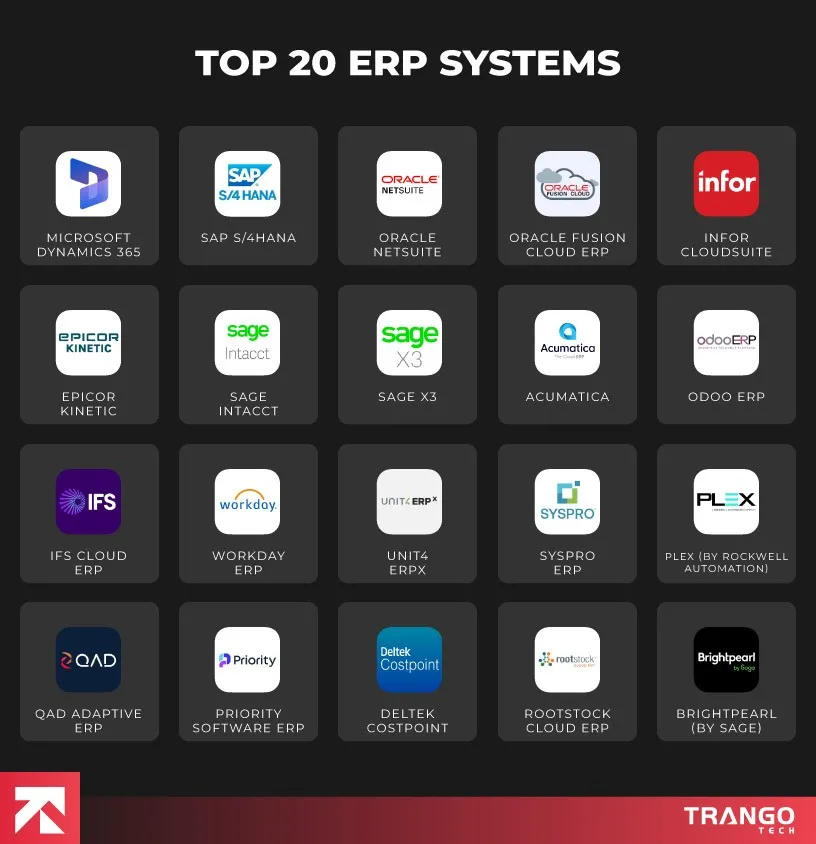
The biggest, most widely deployed ERP software platforms globally are Microsoft Dynamics 365, SAP S/4HANA, Oracle NetSuite, Oracle Fusion Cloud ERP, Infor CloudSuite, Epicor Kinetic, Sage Intacct, Acumatica, Odoo, and Workday. These global ERP software vendors lead on scale, partner ecosystem, and breadth of industry coverage. The full top 20 list above adds specialist and mid-market platforms worth shortlisting. Now let’s compare each ERP software in depth to help you shortlist the right fit.
Microsoft Dynamics 365 brings ERP and CRM capabilities in a single platform to help SMBs and global enterprises. This cloud-first platform is a versatile ERP system in 2026, allowing businesses to scale and expand operations worldwide. Partner with Microsoft Dynamics 365 Partner in Florida to utilize the best small business ERP solution.
Manufacturing, construction, retail, professional services, healthcare, and distribution.
Microsoft Copilot in Dynamics 365 automates reporting, forecasting, and customer interactions. Embedded AI streamlines supply chain predictions and fraud detection with the best ERP for the construction Industry.
Seamless integration with Microsoft Dynamics 365, Teams, Microsoft Power BI Services, LinkedIn Sales Navigator, Shopify, and third-party apps.
Modern UI, mobile-first design, role-based dashboards, and AI-driven recommendations.
Highly customizable with low-code Power Apps and extensive API support; scalable from startups to Fortune 500s. Also evaluate Power Apps cost to balance customization with budget.
A global network of Microsoft-certified partners, such as Trango Tech, offers industry-specific solutions.
$80,000–$1M+ (depending on modules and scale). Best fit: SMBs to enterprises seeking a modular cloud ERP with CRM built in.
Organizations that need a scalable, integrated ERP + CRM and need Business Central implementation services that extend functionality.
Also Read: What is Microsoft Dynamics 365
SAP S/4HANA is one of the top ERP systems that caters to the needs of enterprises that require global scalability, advanced customization, and industry-specific depth.
Manufacturing, oil & gas, utilities, healthcare, life sciences, public sector.
The ERP is delivered as a Software-as-a-Service (SaaS) on the cloud, and businesses can access it through a web browser. It does not require any heavy investment.
Automatic updates and patches with Lower upfront costs (subscription-based) and can scale easily as the business grows.
The top ERP systems can run in both cloud and on-premise environments at the same time.
Businesses can keep sensitive workloads on-premise.
Ideal for those who want on-premise deployments with strict compliance, data sovereignty, or security regulations (e.g., government, healthcare, defense).
Meets regulatory requirements with high control over data and system security.
SAP Business AI powers predictive analytics, demand forecasting, and anomaly detection in supply chains. Intelligent Robotic Process Automation (iRPA) is integrated into workflows.
Strong native integration with SAP Ariba, Concur, SuccessFactors, and third-party enterprise platforms.
Fiori UX provides role-based dashboards, with mobile access available. However, there is a steep learning curve for new users.
Extremely scalable with industry add-ons, but customization often requires expert consultants and longer implementations.
Extensive global partner ecosystem with both large system integrators (Accenture, Deloitte) and niche industry consultants.
$500,000–$5M+ depending on scale and customization. Best for Fortune 500s and heavily regulated or complex industries.
Global enterprises with complex supply chains and multi-country operations.
Also Read: Microsoft Dynamics 365 Vs. SAP
NetSuite serves all the fast-scaling companies with a cloud-native ERP. It is an ERP financial software with management and multi-subsidiary consolidation features.
Retail, wholesale distribution, eCommerce, professional services, SaaS companies.
Cloud-only SaaS.
AI-driven financial close, predictive inventory management, and embedded analytics.
Integrates with Shopify, Salesforce, HubSpot, Amazon, and custom APIs.
Clean UI with customizable dashboards; mobile support available.
Scales from SMB to mid-market enterprise; SuiteCloud enables low-code customization.
Robust partner network with VARs and consultants worldwide; strong Oracle support.
$40,000–$250,000 annually. Best for high-growth mid-market businesses, eCommerce, and SaaS firms.
Fast-growing mid-sized companies require a scalable cloud ERP financial software with global accounting and financial consolidation capabilities.
Oracle Fusion Cloud ERP offers strong AI features and global compliance support. Large, multinational organizations can unify operations across finance, supply chain, HR, and procurement.
Banking, telecom, professional services, healthcare, and manufacturing.
Cloud-native SaaS only.
Embedded AI for forecasting, expense management, and financial close. Intelligent automation reduces manual processing across supply chains.
Strong integration with Oracle Cloud apps (HCM, CX, SCM) plus connectors for Salesforce, Workday, and other enterprise apps.
Modern UX with role-based dashboards, natural language queries, and mobile app support.
Highly scalable for global enterprises; supports low-code extensions through Oracle Visual Builder.
Backed by Oracle’s worldwide partner ecosystem, including global system integrators and boutique consultants.
$300,000–$3M+ annually. Best for large multinational enterprises with global operations.
Enterprises seeking a fully integrated, AI-powered ERP for global finance and operations.
Infor CloudSuite offers industry-tailored ERP solutions with cloud-first and AWS security and scalability. It delivers strong vertical expertise for manufacturing, healthcare, distribution, and hospitality.
Manufacturing, healthcare, retail, hospitality, distribution, and the public sector.
Cloud-first SaaS on AWS, with hybrid support.
Infor Coleman AI assists in demand planning, workforce scheduling, and predictive maintenance.
Built-in integrations with AWS services, Salesforce, Shopify, and custom APIs.
Modern UX (Infor OS), mobile accessibility, and industry-specific templates.
Highly customizable with micro-vertical functionality and industry-specific extensions.
Strong partner network with both global and regional specialists; Infor also provides direct consulting.
$200,000–$2M+ depending on industry modules. Best for mid-sized to large enterprises in specialized industries.
Companies seeking an ERP designed for healthcare, manufacturing, and hospitality.

Epicor Kinetic is designed for manufacturers and distributors in mind so that they can handle strong production management, shop floor control, and supply chain visibility. This makes it a go-to ERP for industrial businesses.
Discrete manufacturing, automotive, aerospace, industrial equipment, and distribution.
Cloud, on-premise, and hybrid.
Predictive analytics for demand forecasting, automated production scheduling, and IoT-enabled shop floor data.
Integrates with CAD systems, Salesforce, Shopify, and other supply chain platforms.
Role-based dashboards, mobile access, and real-time shop floor visibility.
Highly customizable for manufacturers; scales from SMBs to mid-market industrial companies.
Supported by Epicor’s certified partners, with a strong presence in North America and Europe.
$100,000–$1M+ depending on scale and modules. Best for manufacturing SMBs to mid-market enterprises.
Industrial companies that need deep manufacturing and supply chain ERP functionality.
Sage Intacct streamlines accounting and financial management for SMBs and mid-sized organizations with strong automation, multi-entity consolidation, and compliance without the complexity of a large-scale ERP.
Nonprofits, professional services, healthcare, and SaaS firms.
Cloud-only SaaS.
One of the best ERP systems, AI automates expense tracking, reconciliations, and compliance checks. Automated workflows speed up accounts payable and revenue recognition.
Connects with Salesforce, ADP, Bill.com, Expensify, and hundreds of financial add-ons.
User-friendly dashboards, strong reporting features, and mobile access.
Scales from small businesses to mid-market companies; limited beyond finance-heavy functions.
Strong partner network in North America; consultants available for nonprofit and finance-centric industries.
$25,000–$150,000 annually. Best for SMBs and nonprofits that need a robust financial enterprise resource planning software.
Organizations prioritizing financial management, compliance, and reporting without full ERP complexity.

Sage X3 provides comprehensive and top ERP software functionality with a global reach. All mid-sized businesses that need multi-country operations, manufacturing, and supply chain capabilities can utilize it.
Manufacturing, distribution, food & beverage, pharmaceuticals.
Cloud, on-premise, or hybrid.
AI-enabled demand forecasting, automated compliance reporting, and workflow automation.
Integrates with Salesforce, Magento, Shopify, and other supply chain/retail systems.
Intuitive web-based interface with role-based dashboards; available on mobile.
More customizable than Sage Intacct; scales well for mid-market and global midsize companies.
Global partner presence is smaller than the SAP/Oracle ecosystems.
$50,000–$500,000 annually. Best for mid-sized businesses with multi-country operations.
Companies seeking a cost-effective, mid-market enterprise resource planning software with global reach and compliance support.
Acumatica is a pocket-friendly, modern, cloud-native ERP software solution. It is easy to use, and businesses can customize their ERP without incurring significant costs.
Cloud-native SaaS; hybrid options available through partners.
AI-driven dashboards, predictive sales forecasts, and automated workflows across finance and supply chain.
The top ERP systems have strong API support; they integrate with Shopify, Salesforce, HubSpot, and Microsoft apps.
User-friendly interface, mobile apps, and browser-based access.
Highly flexible with low-code customization; scales well for SMBs and mid-market companies.
Partner-led model with resellers and consultants worldwide; strong US presence.
$25,000–$200,000 annually. Best for SMBs and mid-market businesses looking for affordable ERP flexibility.
Organizations that need a cloud ERP with high customization and scalability at a lower cost.
You may also like to read: Business Central Vs. Acumatica
Odoo is a customizable ERP and the most flexible ERP software. It comes with 30 core modules and 20,000+ community apps. Many SMBs and startups opt for it due to its affordable costs.
Retail, manufacturing, services, startups, and eCommerce.
AI-driven lead scoring, invoice automation, and inventory demand prediction.
Marketplace with 20,000+ third-party apps; integrates with Shopify, WooCommerce, Salesforce, and payment gateways.
Modern interface, drag-and-drop website builder, mobile support.
Extremely flexible and customizable through open-source modules; best for SMBs and growing businesses.
Large global community plus Odoo-certified partners for enterprise-grade implementations.
Free for community edition; enterprise edition starts at ~$24/user/month. Best for SMBs/startups needing a customizable ERP.
Businesses that value open-source flexibility and low entry cost.
IFS Cloud ERP allows aviation, energy, construction, and field service-heavy industries. To handle complex asset management and project-driven operations.
Aerospace, defense, utilities, construction, energy, and mining.
Modern, mobile-friendly design; role-based dashboards optimized for field service.
Scales well for mid-sized to enterprise organizations with asset-intensive operations.
Strong European presence; growing global network of partners and consultants.
$200,000–$2M+. Best for asset-heavy industries with complex operations.
Companies with asset-intensive, project-driven operations.
Workday offers a comprehensive solution for HCM and financial management, encompassing HR, payroll, and enterprise financial planning. The people-centric design makes it the go-to ERP for large service-focused enterprises.
Education, healthcare, finance, government, and large enterprises.
Cloud SaaS only.
AI for recruiting, skills matching, workforce forecasting, and financial planning.
Connects with Salesforce, SAP, Microsoft, and a wide range of HR/payroll platforms.
Clean, modern UX; strong mobile app; employee self-service portals.
Scales from mid-market to enterprise; strong HCM focus but less suited for manufacturing-heavy industries.
Large global ecosystem of Workday-certified consultants and service providers.
$250,000–$2M+ annually. Best for large enterprises in service-focused sectors.
Organizations prioritizing HR, payroll, and financial management over supply chain/manufacturing.
Unit4 ERPx facilitates service-based, people-centric organizations like nonprofits, the public sector, and higher education. Now, these organizations can manage projects, people, and finances in a single, unified system.
Nonprofits, professional services, higher education, government, and the public sector.
Cloud SaaS only.
AI automates project forecasting, budgeting, and workforce planning. Natural language chatbots assist users with data queries.
Integrates with Microsoft, Salesforce, and various HR/payroll solutions.
Intuitive UI;
mobile-first design for employees and managers.
Scales well for mid-market organizations; less suited for heavy manufacturing.
Strong presence in Europe and North America; dedicated Unit4 partners for nonprofits and education.
$100,000–$500,000 annually. Best for mid-sized nonprofits and service-driven organizations.
Organizations that need a people-focused ERP with strong project and financial management.
SYSPRO works best for mid-market manufacturers and distributors, enabling them to automate their supply chain, production, and financial capabilities with flexible deployment options.
Manufacturing, food & beverage, automotive, and industrial equipment.
AI enhances demand forecasting, quality control, and predictive analytics for production.
Integrates with CAD, eCommerce, Microsoft, and industry-specific solutions.
Simple UI with customizable dashboards; mobile-enabled.
Scales well for SMBs and mid-market; customizable with APIs and add-ons.
Strong global partner network and one of the top ERP systems for manufacturing.
$75,000–$500,000 annually. Best for SMB/mid-market manufacturers.
Manufacturers and distributors are seeking a cost-effective and the best ERP software system with robust production management capabilities.

Plex is among the cloud ERP software catering to modern manufacturers, offering real-time shop floor control and IoT-driven insights.
Automotive, aerospace, food & beverage, and high-tech manufacturing.
Cloud-only SaaS.
AI powers predictive maintenance, quality defect detection, and production forecasting.
Integrates with IoT devices, CAD, and automation systems; strong compatibility with Rockwell Automation solutions.
Real-time dashboards for shop floor visibility; mobile-ready access for supervisors and operators.
Built for mid-sized to large manufacturers; customizable with APIs and extensions.
Supported by Rockwell Automation’s global partner network.
$150,000–$1M+. Best for mid-sized manufacturers with smart factory ambitions.
Manufacturers seeking ERP + MES integration for Industry 4.0 operations.

Manufacturers operating globally across multiple sites require the QAD Adaptive ERP solution. It offers strong supply chain and compliance capabilities.
Automotive, life sciences, consumer products, food & beverage, and high-tech manufacturing.
Cloud, on-premise, or hybrid.
AI-enabled demand forecasting, production optimization, and supplier risk detection.
Integrates with Microsoft, Salesforce, CAD, and PLM systems.
Role-based dashboards, multilingual UI, and mobile support.
Designed for enterprises with global operations; supports local tax, compliance, and regulatory frameworks.
Strong partner network in North America, Europe, and Asia-Pacific.
$200,000–$2M+. Best for multinational manufacturers.
Global manufacturers need multi-country compliance and adaptive supply chain management.
SMBs need the best ERP software with flexibility, modularity, and lower cost compared to larger enterprise systems. Priority ERP covers a wide range of industries with simple yet powerful ERP functionality.
Retail, manufacturing, healthcare, construction, and professional services.
Cloud, on-premise, and mobile-first.
AI for demand planning, automation of workflows, and predictive analytics.
Integrates with Shopify, Salesforce, Microsoft, and many SMB-focused apps.
Simple and user-friendly, the mobile app is widely used by SMBs.
Scales from startups to mid-market businesses; API-driven customization.
Global presence with strong support in Europe, the US, and Asia.
Starts at ~$50,000 annually. The best ERP software for SMBs needing an agile solution.
Small and mid-sized businesses seeking an affordable yet scalable ERP.
Government contractors, project-based businesses, and defense suppliers can utilize Deltek Costpoint, which includes compliance, project costing, and reporting capabilities.
Government contractors, aerospace, defense, and project-based industries.
Cloud or on-premises.
AI improves project forecasting, compliance monitoring, and risk management.
Integrates with Microsoft Project, payroll systems, and government compliance software.
Compliance-heavy dashboards; secure mobile access for field employees.
Tailored for project-based enterprises; scalable for midsize to large organizations.
Specialized partners for government and defense sectors.
$100,000–$1M+. Best for government contractors.
Contractors and project-driven organizations require strict government compliance.
Rootstock is the top ERP system choice for companies already invested in Salesforce. It brings a blend of manufacturing, supply chain, and financial features.
Manufacturing, distribution, high-tech, and life sciences.
Cloud SaaS (Salesforce-native).
Leverages Salesforce Einstein AI for demand forecasting, sales insights, and predictive analytics.
Seamless with the Salesforce ecosystem and AppExchange apps.
Salesforce UI familiarity; mobile access via the Salesforce app.
Highly customizable through Salesforce Lightning and AppExchange.
Supported by Salesforce’s global ecosystem plus Rootstock-certified partners.
$100,000–$750,000 annually. Best for Salesforce-first companies.
Manufacturers and distributors are already using Salesforce CRM.

Brightpearl is built for omnichannel commerce, order management, and inventory optimization.
Retail, wholesale, eCommerce, and distribution.
Cloud SaaS.
AI-driven demand forecasting, automated order routing, and personalized customer analytics.
Integrates with Shopify, Magento, Amazon, eBay, and accounting software.
Retail-friendly UI; built-in POS system for stores; mobile-enabled.
Scales from SMBs to large retailers with multi-store and omnichannel needs.
Strong Sage partner ecosystem plus retail-specialized consultants.
Starts at ~$80,000 annually. Best for omnichannel retailers.
Retail and wholesale companies seeking omnichannel ERP software with strong eCommerce integrations.
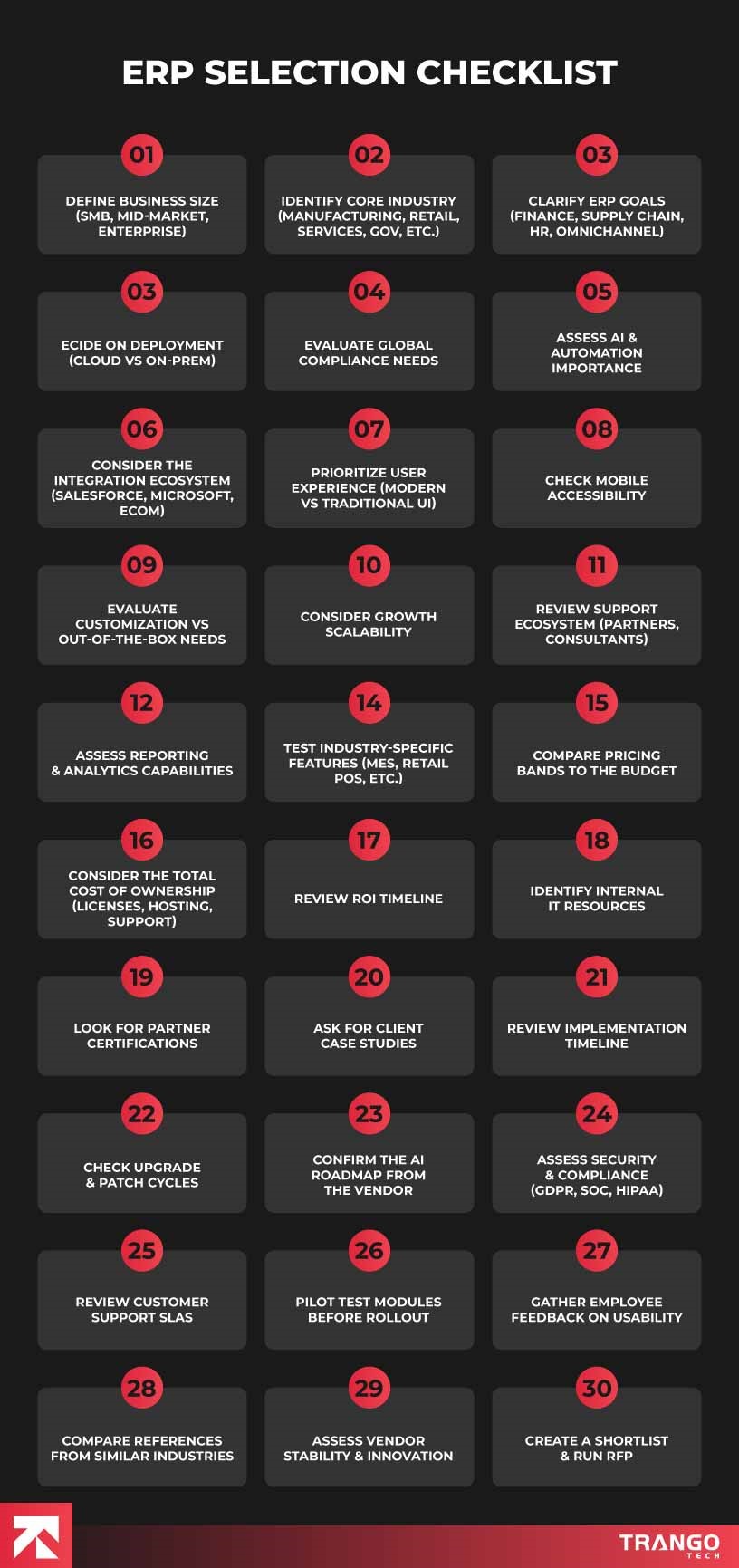
Utilize the comparison matrix and 30-point checklist to evaluate ERP vendors and invest in a system that scales with your growth.
Businesses must connect with certified ERP experts for Business Central development services, SAP customization, or Odoo configuration to unlock automation, scalability, and more intelligent decision-making to stay competitive in 2026 and beyond.

The top ERP systems, like Microsoft Dynamics 365, automate a wide range of tasks and provide a single source of truth for data across departments. An ERP known for rapid deployment offers significant benefits. Enterprise Resource Planning software unifies finance, supply chain, HR, and operations into a single platform. In 2026, the best ERP systems will leverage AI, automation, and industry-specific capabilities to help organizations scale faster and smarter.
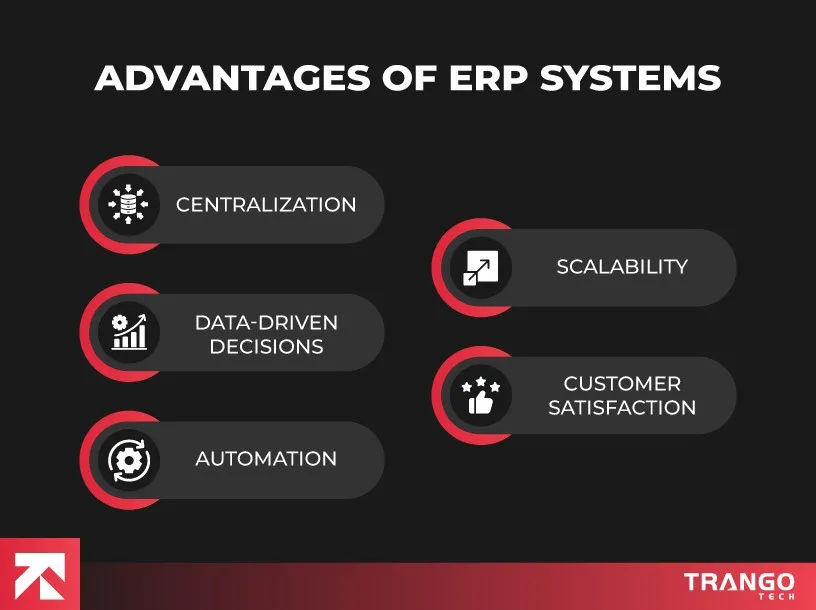
ERP systems have taken the world by storm due to their numerous advantages. It is no longer just an option; in today’s fast-paced digital economy, businesses can operate more efficiently.
In 2026, ERP for fast implementations offers advanced tools with cloud deployments, AI-powered analytics, and industry-specific features.
The key advantages of ERP systems are:
ERP systems unify business operations into a single, integrated platform. Instead of relying on scattered software tools, it eliminates silos, reduce duplicate data entry, and enable growing companies to drive efficiency at scale.
ERP systems offer a smarter solution to businesses with built-in analytics, dashboards, and AI-powered forecasting. Companies can make smarter choices by predicting demand, controlling costs, or spotting new market opportunities.
ERP systems streamline manual and time-consuming tasks like data entry, invoice processing, order tracking, and reporting. Automation saves employees time so they can focus on strategic initiatives rather than administrative work. Manufacturing and the food industry can ensure compliance with stringent regulatory standards.
Scalability is not an option for any business. This key advantage allows businesses to add new modules, industry-specific features, or cloud integrations. This flexibility enables small businesses to begin with essential functions and gradually incorporate advanced features.
ERP systems improve customer satisfaction by improving the operations of retail, food, and e-commerce businesses. They can utilize it to maintain accurate inventory levels, achieve faster response times, and provide personalized customer interactions. This helps them to gain long-term success.
You can only fully enjoy the benefits, if you implement the right ERP system. This is why you need to define ERP System requirements to ensure successful implementation.
There are many ERP software solutions built for various industries, business sizes, and strategic priorities. Microsoft Dynamics 365 stands out for its flexible, modular design when delivered through an experienced Microsoft Dynamics 365 Partner in Houston.
Whereas SAP S/4HANA dominates large-scale enterprises, Infor CloudSuite delivers robust industry-specific ERP solutions across healthcare, manufacturing, and hospitality. Odoo ERP is known for its open-source flexibility and thousands of apps that need affordable customization.
Finally, you can choose the best ERP software after considering industry needs, growth stage, and long-term strategy. Choose Microsoft Dynamics 365 for its seamless Microsoft ecosystem integration, SAP for its deep enterprise capabilities, Infor for vertical-specific solutions, or Odoo for its affordability—partner with the right consultant like Trango Tech.
Dynamics 365, Priority, Odoo, and Sage Intacct are known for SMBs due to affordability and faster deployment.
SAP S/4HANA is built for large, complex enterprises with heavy customization. Dynamics 365 is more flexible, modular, and SMB-to-enterprise friendly.
ERP costs range from $20K/year for SMB ERPs to $5M+ for enterprise rollouts.
Epicor Kinetic, SAP S/4HANA, SYSPRO, and Infor CloudSuite offer the deepest manufacturing-specific functionality, including MES and shop floor control. Microsoft Dynamics 365 Supply Chain Management is the stronger choice for manufacturers who also need CRM, field service, or tight Microsoft 365 integration in the same platform.
Many brands are recognized for their distinct pricing strategies, which include:
It offers a unique consumption-based pricing model.
Odoo offers a flat-rate per-user enterprise model with a modular pricing strategy.
The SaaS subscription model with a core platform base fee, named user licenses, and modules.
It offers an affordable solution with modular pricing.
Microsoft, SAP, Oracle, IFS, Infor, and Workday are recognized as the primary drivers of innovation.
The major ERP brands dominating the market are SAP, Oracle, Microsoft Dynamics 365, Infor, Workday, and Epicor.
Yes, it is flexible, affordable, modular, and the best ERP for small businesses and startups.
SAP offers solutions for large, complex enterprises, and Dynamics 365 is suitable for SMBs and enterprises.
Microsoft Dynamics 365 Commerce leads for retailers who need POS, e-commerce, call centre, and back office running against a single customer record. Brightpearl by Sage suits smaller wholesale-led retailers wanting faster time to value, while NetSuite and Odoo are strong alternatives for eCommerce-first businesses.
Yes. SYSPRO is our top pick for mid-market food and beverage producers, with native lot tracking, batch management, and quality control. Infor CloudSuite and Sage X3 are strong alternatives for multi-country operations. Dynamics 365 supports food and beverage through its supply chain and quality modules, and suits producers who want ERP and CRM on one platform.
Yes, Business Central is a scalable and affordable choice for startups that avoid the need for constantly changing software. Moreover, Microsoft Business Central Support service ensures the seamless operation of your business.
Infor CloudSuite and SAP S/4HANA offer industry expertise across healthcare, manufacturing, utilities, and hospitality.
Acumatica and NetSuite are cloud-first ERPs, while Microsoft Dynamics 365 and Odoo also provide strong SaaS-based deployments.
The risks include poor change management, high customization costs, and low user adoption.
Use a structured checklist and compare solutions like Dynamics 365, Odoo, SAP, and Infor to find the right fit.
Yes, for manufacturers who value breadth over shop floor depth. Dynamics 365 Supply Chain Management delivers AI-driven demand forecasting, production planning, and Power Platform extensibility. Manufacturers needing deep MES and real-time shop floor control usually get closer functional fit from Epicor Kinetic or Plex.
Calculate your complete ERP implementation cost using our cost calculator.
Calculate now!
Your Email Address Will not be published. Required Fields Are Marked
Quick Answer (TL;DR) ERP systems solve real operational problems across 10 core business functions: finance, procurement, inventory, manufacturing,…

Quick Answer (TL;DR) Companies switch from Odoo to Business Central when they need a system that can scale…

Quick Answer (TL;DR) The top 20 CRM software options in 2026 include Salesforce Sales Cloud, Microsoft Dynamics 365…
Quick Answer (TL;DR) ERP systems solve real operational problems across 10 core business functions: finance, procurement, inventory, manufacturing,…
Quick Answer (TL;DR) Companies switch from Odoo to Business Central when they need a system that can scale…
Quick Answer (TL;DR) The top 20 CRM software options in 2026 include Salesforce Sales Cloud, Microsoft Dynamics 365…
If you are confused and need expert advice to transform your business, our experts are available 24/7.
Don't waste a single second, as you will be left behind while others are already ahead, moving fast. Start Now!
Trusted by Clients Worldwide: Rated 4.9 Star