Business Central Vs. Finance and Operations: What’s the Difference?
Business Central Vs. Finance and Operations: What’s the Difference?
Updated: March 5, 2026
10 min
586 views
Written By: Alishba Khan
Senior ERP Content Writer
Fact Checked By: Ahsan Shahid
D365 Specialist
Share
Business Central and Finance and Operations are the products of Dynamics 365 Business Central, but serve businesses of different sizes. Business Central caters to small businesses and mid-market enterprises, while Finance and Operations serves large enterprises.
Both solutions belong to the same system but serve different purposes. They address the needs of businesses based on size, complexity, and operational requirements. This is why understanding D365 Business Central vs. Finance and Operations is important for making the right choice.
The core motive of Finance and Operations implementation will only be fulfilled if you use the right system and select the right Microsoft Dynamics 365 ERP consulting partner. Selecting the wrong fit leads to chaos and leaves teams dissatisfied.
What is 365 Finance and Operations
Dynamics 365 Finance and Operations is used to streamline finance and operational systems. This solution is designed to meet the needs of large organizations.
Dynamics F&O is an integration of:
D365 Finance & D365 Supply Chain
Finance handles all finance-related work, including budgeting, project management, and forecasting.
Supply chain management includes all the distribution, inventory, and warehouse management. Both systems can be used simultaneously or together to achieve the desired results.
Don’t let your competitors outpace you.
Partner with Trango Tech to launch impactful digital solutions fast.
Businesses with complex needs or large organizations can leverage Finance and Operations to benefit from advanced finance and supply chain management capabilities. The system can be configured as per the individual needs of a business.
Also, the system’s cost is higher than Business Central’s.
Core Strength
Supports multicurrency, multientity operations
Compliance and security
Advanced financial management
Transport management
Warehouse management
What is Dynamics 365 Business Central
Dynamics 365 Business Central is Microsoft’s ERP solution that meets the needs of all small and medium-sized businesses. It streamlines the core business processes of an organization and automates inventory, sales, finance, manufacturing, purchasing, and accounting.
It is a user-friendly solution designed to simplify a business’s daily operations without complexity. Business Central is a robust solution that aims to ease the burden of small and mid-sized businesses struggling with unstructured, disconnected systems.Business Central is an affordable, popular solution for businesses that need a system to streamline daily operations. It can easily integrate to third party platforms like Shopify usingDynamics 365 Shopify integration.
Moreover, Partners provide D365 Business Central support services to assist businesses in resolving issues and offering post implementation support.
Core strength
Project management
Finance management
Sales
HRMS
Also Read: What is Dynamics 365 Business Central
Real World ERP Implementation Issues
There are several examples of businesses choosing the wrong system that led to chaos. The organization initially acquired Business Central. But Business Central Implementation couldn’t keep up as the transaction volume increased, it felt the need to migrate to Finance and Operations.
And when Enterprises chose Finance and Operation and wasted a lot of money, they actually needed Business Central to achieve reduced operational overheads and a great ROI.
Why Microsoft Built Two Business Solutions
Microsoft launched these two business solutions to fulfill the needs of different types of businesses. Business Central offers standard features that boost businesses with automated workflows and limited organizational layers.
Finance and Operations handles complex business requirements, including approval hierarchies, multi-entity operations, and strict financial governance.
Extension Ecosystem vs ISV Dependency
Again, there is a distinction in the two systems’ extension ecosystems because they serve different markets.
So, Business Central uses a modular app ecosystem and offers F &O, which offers deep native customization.
Dynamics 365 Business Central: The Modular App Ecosystem
Extension approach
AL extensions are used to keep the base code safe.
ISV & AppSource
Microsoft AppSource has more than 7,000 ISV Apps to meet the needs of industries.
Dependency
Used for adding functionalities that are not basic.
Flexibility
Ensures quicker implementation with high flexibility. However, conflicts may arise during updates.
Dynamics 365 Finance & Operations: Deep Native Functionality
Extension approach
F&O offers extensive X++ customization for large-scale workflows. The system is tailored according to the needs of the businesses.
ISV Dependency
It already includes out-of-the-box functionality for core processes, and ISVs are used for high-level functionality.
Upgrade impact
Upgrades need to be planned as managing them during updates can be complex due to heavy customization.
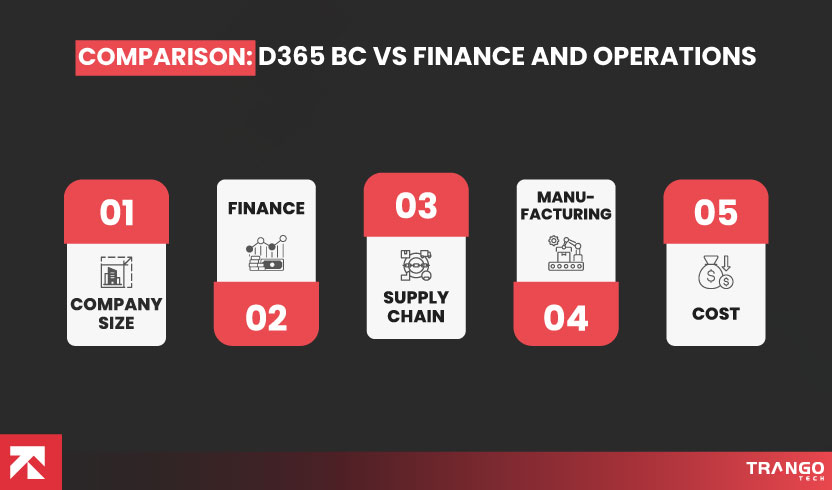
Comparison: D365 BC vs Finance and Operations
Company Size
Small and mid-sized businesses have a simpler ecosystem with fewer people. Dynamics 365 Business Central caters to the needs of these businesses by simplifying and automating core business processes.
There are no hard-and-fast rules that lead to complexity. The ERP software fulfills the needs as long as there is no intercompany logic. As the business grows, there is a need for a system that can handle more load.
Dynamics 365 Finance allows large organizations to manage global operations through a single system.
Financial Complexity
Small businesses need a system that is capable of handling basic AP and AR functions. Business Central comes with all the features enabling businesses to have automated workflows while also utilizing intelligent forecasting. From general ledger maintenance to managing fixed assets and performing bank reconciliation, Business Central takes care of everything.
The multicurrency payment processing and a clear view of finances offer transparency and increased visibility.
Now, when it comes to large businesses or those that are growing, a simple system cannot meet the needs with a standard setup. The requirements grow as the business scales. The complex financial hurdles require an advanced system capable of handling them.
These requirements include global and multi-entity management, global compliance and security, advanced analytics, intelligent accounting, and integrated treasury management.
You get tighter deadlines and faster month-end closing, and Dynamics 365 Finance and Operations handles all these functions.
Supply Chain And Inventory Planning
Business Central ensures your supply chain stays on track through inventory optimization and a live data view of your operations. No aspect of your supply chain is disturbed as it handles everything from preparation to storage.
Manage your entire supply chain using a single solution that makes traceability easier than ever. Check what’s in your inventory, plan accordingly, and improve your demand planning.
Whereas Finance and Operations handles complex processes with its robust features. It’s built for large organizations that need advanced procurement and warehouse management features. It’s for businesses that need more than a standard system.
Finance and Operations supports businesses with faster replenishment cycles. All operations are processed at lightning speed, offering mobility, scalability, and reliability.
Manufacturing And Operation
Business Central handles manufacturing operations through accurate costing and streamlining of operations.
You can manage component lists, routing, and production lifecycle by abandoning standalone tools. It tracks every step during the production lifecycle while offering complete visibility into operations.
Microsoft Dynamics Finance and Operations streamlines production to increase productivity while reducing operational costs. It unifies supply chain, project management, and accounting for better financial control and resource utilization.
AI-powered insights, consolidated financial reporting, and automated operations improve the supply chain processes.
Custom Workflows And Extensions
Growth is an inevitable part of a business, as it may feel the need to add new features at any time. Business Central supports adding new features with its scalable model. It saves from the hassle of depending on vendors or developers to add custom APIs.
Business Central offers AL extensions and supports low-code customization. Businesses can easily extend functionality without any complexity.
Dynamics F & O offers custom code design to meet the business’s needs. Customization comes with a high cost and an IT infrastructure that the organization needs to maintain.
Implementation Costs BC Vs F&O
Business Central does not take long to implement. It can take a few weeks, depending on the modules the business is acquiring. There are no infrastructure requirements to fulfill.
In contrast, Finance and operations implementation takes more than 6 months, especially if there are greater complexities. The extensive testing and phased rollout ensure effective change management and adoption.
Explore the Microsoft Dynamics 365 implementation guide to understand the process.
Cost Comparison
Business Central
No infrastructure requirements
Reduce costs
Minimal support cost
Dynamics Finance and Operations
Customization cost
Increased costs
Support cost
Scalability and Growth
A system that doesn’t allow you to scale can be catastrophic. But that is not the case with Business Central. New resources, like people and technology, help increase revenue. It allows businesses to easily add hundreds of users. Businesses can easily handle increased demand thanks to their ERP’s scalability.
Dynamics Finance and Operations handles system growth as it supports massive user volumes or feature sets. The performance is maintained to ensure long-term growth and stability.
Reporting Analytics And Intelligence
As far as reporting and analytics are concerned, Business Central offers advanced reporting through Power BI and Azure service integration. Stakeholders can use dashboards to view the updates in real time and measure the KPIs.
Finance and operations also provide advanced reporting and analytics utilizing Power BI integration.
Also Read: The Complete Dynamics 65 Integration Guide
What Is An Implementation About
ERP implementation is a major decision that requires careful thought and planning. A transparent view of the system before its implementation will give you a clear picture, clearing all your doubts. You need to understand the practical realities to see what’s coming your way.
Project Scope And Timeline Expectations
Business Central can be implemented in a phased rollout with the help of an experienced partner. An internal team can collaborate with the partner to implement the system.
Whereas for finance and operations, you need to involve stakeholders from every department.
Migration
Migration in Business Central is done using AL extensions, third-party apps, and AI integrations. The Business Central migration process is very simple, with no added complexity. Moreover, historical data cleaning may take time.
Migration in F&O requires data mapping across global currencies and entities. It undergoes extensive testing, and mapping becomes time-consuming.
Change Management And User Adoption
Role-based training can be done to use the system. A little understanding of the system makes it easier for users to use.
F&O requires training due to a steep learning curve. Technical understanding of the system is significant for adopting the system. Business intelligence tools and power platforms are integrated to provide a simpler, user-friendly experience. This integration allows the user to use the system without any restrictions.
Critical Aspects To Consider While Selecting An ERP System
Any business considering acquiring an ERP system needs to assess its needs immediately. The most important thing is to draft a plan and make ERP requirements. Therefore, it is necessary to define the budget, timeline, and other key conditions. Failing to define goals will make it harder for you to reach them.
Conclusion
Business Central is a reliable solution that helps SMBs grow and scale alongside their businesses. On the other hand, Dynamics F&O caters to the needs of large enterprises with complex requirements.
Enterprises should select the right system from Dynamics Business Central vs. Finance and Operations to reap the benefits of the system. It is a major decision that can affect a business’s ROI and efficiency. Businesses must analyze their operational needs to make the right decision.
Trango Tech, a certified Microsoft Solutions Partner, transforms businesses by offering tailored ERP solutions that deliver a high return on investment (ROI).
Begin your Business Central implementation journey.
Frequently Asked Questions :
Business Central is a tailored solution catering to the needs of small and mid-sized businesses, while Finance & Operations is built to meet the needs of large organizations.
Business Central can meet the needs of both small and medium-sized businesses.
Business Central supports multicurrency and multicompany operations to support global operations.
Business Central implementations may be completed within 3-6 months, whereas F&O implementations may take longer due to extensive customization.
Business Central upgrades are simpler and do not require planning, while Finance and Operations upgrades must be planned.
Business Central can scale to some extent, whereas Finance & Operations offers excessive customization.
About author
Alishba Agha is a Senior ERP Content Writer specializing in Dynamics 365 and Business Central, creating actionable guides on ERP migrations, ecommerce integrations like Magento multi-warehouse sync, and manufacturing workflows for SMBs. With extensive experience, she covers GP-to-Business Central transitions, inventory dimension mapping, and Power BI analytics, transforming complex ERP concepts into clear, SEO-optimized blogs for Trango Tech readers.
Rate this Article
9 ratings, average : 2.2 out of 5
Leave A Reply
Your Email Address Will not be published. Required Fields Are Marked
Related Blogs
All
How We Rescued a Failed Business Central Implementation: A Playbook You Won’t Find in Microsoft Docs
75% of ERP projects fail after implementation for several reasons. The reasons include poor data quality, inefficient business…